The Mythology of Pluto
Prince of Darkness

Pluto, Lord of the Underworld
Pluto’s mythological associations speak of power, magnetism, and potency. Known as ‘Hades’ in ancient Greece, his name was mostly spoken in the form of epithets due to the belief that saying his name aloud could anger this powerful god. The name Pluto — derived from the Greek word plouton, the rich — was eventually adopted by the Romans and subsequently became the planet’s official name after his discovery in 1930. As the ‘Lord of the Underworld’ or the ‘Prince of Darkness', Pluto broods over the obscure kingdom of the Dead, a place beyond the sunset and beneath the Earth anchored by rivers and caves, rich in treasures and mines, and guarded by the fearsome three-headed dog Cerberus. This realm was assigned to him by Saturn and Rhea after the battle with the Titans.
Pluto and Persephone
Little is known of Pluto in the mortal world as he seldom leaves his kingdom. His territory lies far beyond our conscious thoughts, lurking on the fringes of our awareness and seeping into our dreams. The abduction of Persephone from the land of the living is perhaps Pluto’s most well-known feat: daughter of the goddess of harvest and agriculture Demeter, young Persephone captivated him as she gathered flowers in a meadow. Pluto split open the earth beneath her, hurling her into his underground kingdom through the gaping crack and forced Persephone to become his wife.
Demeter’s grief about the loss of her daughter was so profound that plants began to wither, animals died, and famine raged, spelling out doomsday for all of humanity. This delicate situation compelled the other gods to intervene: Persephone must return to her mother and to the land of the living to bring planet Earth back into balance. Prior to leaving the kingdom of the dead, however, Pluto offers Persephone a pomegranate — an ancient symbol of the indissolubility of marriage and the passage from maiden- to womanhood. Eating six seeds of the fruit, Persephone may spend six months of spring and summer above the ground every year, yet is doomed to return to her husband every autumn and winter for the remaining six months. Despite seeming ominous and ruthless, it is Pluto’s passion and determination that ultimately results in the cyclical pattern of the seasons on Earth, and can be seen as a prototype of the cycle of death and rebirth. Even love manages to infiltrate the kingdom of the dead, shining with a magnetic quality that lures us and young Persephone towards the mysterious territory of the unknown.
What does Pluto’s Symbol Mean?
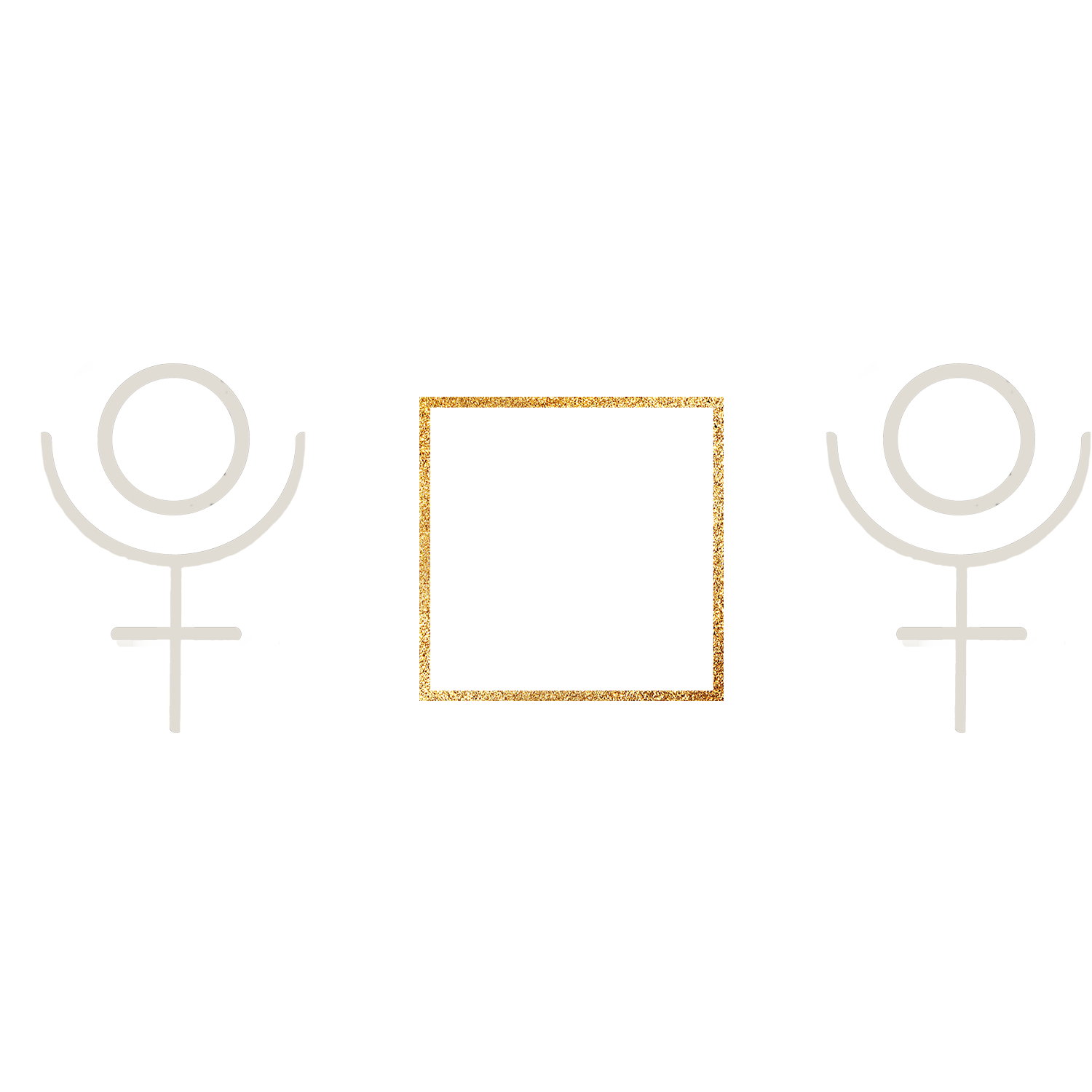
Two glyphs are commonly used for Pluto. The first glyph is a monogram of the letters P and L to eternalise the initials of the planet’s discoverer, Percival Lowell. The second glyph, pictured above, resembles a two-pronged pitchfork with a floating circle hanging between its two prongs. This complex shape reminds us of the alchemist’s crucible, in which substances brew to be transformed into magic, and where lead is transformed into gold. Here, heat intensifies to unbearable extents, purging all that is unnecessary to create the bare skeleton of something new. The disconnected, suspended circle also implies the concentration of power, kept in check by a magical wand without the need for physical restraint — only power of spirit.
Pluto’s Higher Wisdom
Often described as the higher octave of warrior god and planet Mars, Pluto has an affinity with forceful power, raw magnetism and the principle of assertion. Both Mars and Pluto have the ability to be destructive or creative, bullying or supportive, yet our primal survival instinct and our defence of threatened territory is taken to another level with Pluto. Better understood as an evolutionary force that delineates identities and territories by constantly birthing and destroying, Pluto’s eternal cosmic cycle of birth and death, at its highest level, makes him a bringer of light. Pluto adds weight to Mars’s impulsiveness and infuses forceful thrusts of energy with gravitas and density, encouraging profundity of effect and depth of spirit. The worldly courage we muster with Mars turns into serenity of faith with Pluto; hot-headed competition turns into a do-or-die fight for survival; conflict comes to be understood as divine intervention. Read more about Pluto here.